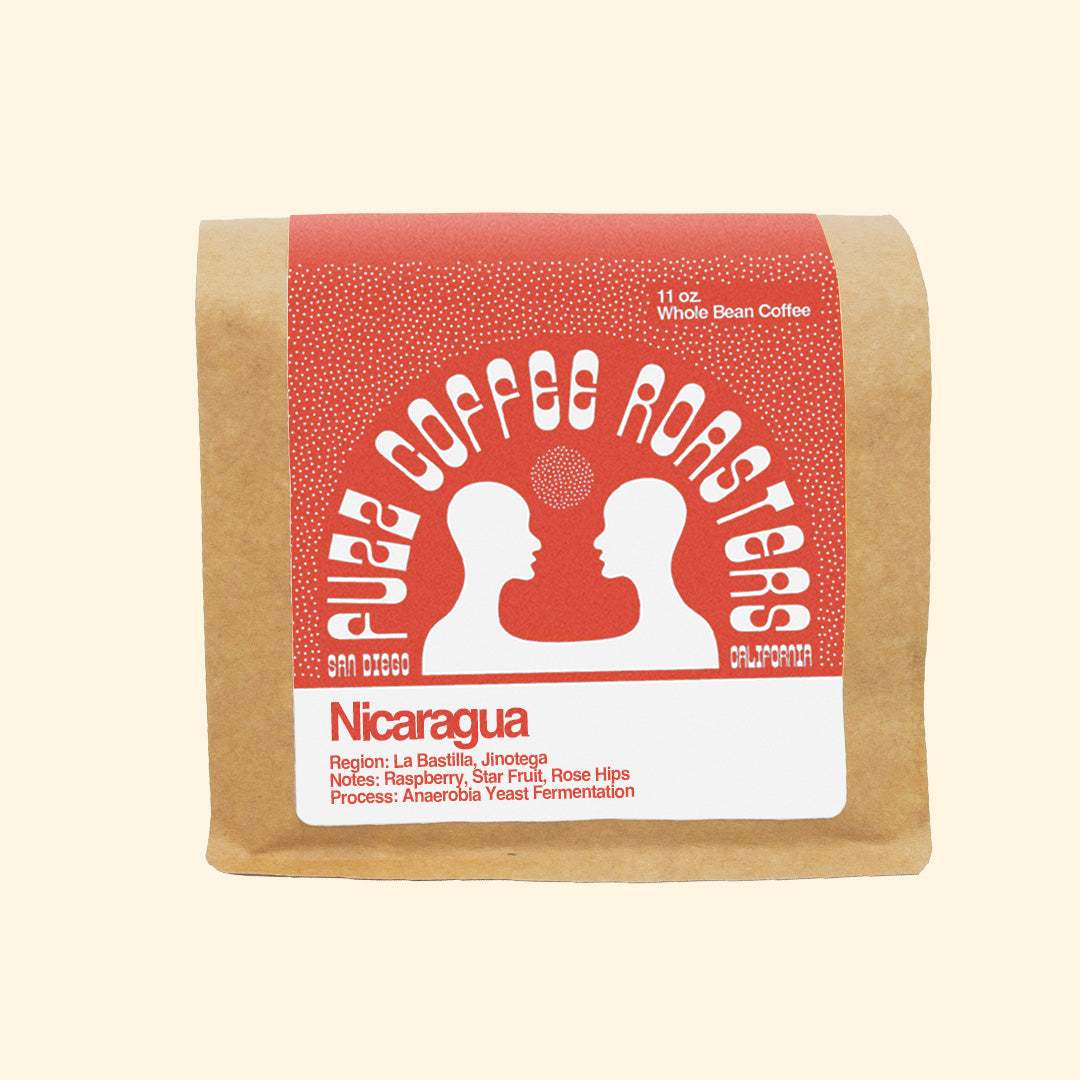
Nicaragua - La Bastilla Yeast Fermentation
Nicaragua - La Bastilla Yeast Fermentation
Region - La Bastilla Estate, Jinotega, Nicaragua
Notes - Raspberry, Star Fruit, Rose Hips
Process - Anaerobic Yeast Fermentation
Varietal: Caturra, Catuai
Altitude: 1300 - 1500 masl
FARM NOTES:
La Bastilla Coffee Estates, located in the north-east region of Jinotega, NIcaragua, is renowned for its coffee. Surrounded by the natural reserve Cerro Datanli El Diablo, just a few kilometers from Lago de Apanas, Finca La Bastilla is a tropical paradise for the fauna and flora founded on deep, favorable volcanic soils. Since 2003, the farm has been certified by the Rainforest Alliance and is striving for continued excellence. On its two farms, Finca La Bastilla and Finca Santa Luz, the estate employs around 50 permanent and up to 600 temporary employees during the harvest season. Micro-farms have been created throughout the estate, so that each coffee can express its full potential in accordance with the different microclimates. Each farm is further divided into lots. Lots are differentiated at the micro-farm level, but also by the variety of the coffee and the altitude.
This unroasted micro-lot coffee underwent a bespoke anaerobic process that utilized specialty yeasts (Saccharomyces cerevisiae) made by Lallemand for fermentation. Ripe red coffees were picked and later placed in steel tanks along with the special yeasts. Subsequently, the oxygen was removed from the tanks and the yeast helped to excite the chemical reactions in the process. During the anaerobic processing, mill managers constantly monitor heat and pH levels. Careful attention ensures strong results.
A Strictly High Grown (SHG) coffee is grown at an altitude of 1,200 meters above sea level or higher. When coffee cherries grow at high altitudes, they tend to mature more slowly. This allows the fruit to take in more nutrients, resulting in denser, sweeter green coffee beans that are considered higher quality. Due to the longer maturation, harvesting and production of SHG coffees generally occurs later in the season. During dry milling, this lot was further sorted to European Preparation (EP) specifications with a minimum screen size of 15 and above and a maximum of eight defects within 300 grams.
____
Read more
Read more
Region - La Bastilla Estate, Jinotega, Nicaragua
Notes - Raspberry, Star Fruit, Rose Hips
Process - Anaerobic Yeast Fermentation
Varietal: Caturra, Catuai
Altitude: 1300 - 1500 masl
FARM NOTES:
La Bastilla Coffee Estates, located in the north-east region of Jinotega, NIcaragua, is renowned for its coffee. Surrounded by the natural reserve Cerro Datanli El Diablo, just a few kilometers from Lago de Apanas, Finca La Bastilla is a tropical paradise for the fauna and flora founded on deep, favorable volcanic soils. Since 2003, the farm has been certified by the Rainforest Alliance and is striving for continued excellence. On its two farms, Finca La Bastilla and Finca Santa Luz, the estate employs around 50 permanent and up to 600 temporary employees during the harvest season. Micro-farms have been created throughout the estate, so that each coffee can express its full potential in accordance with the different microclimates. Each farm is further divided into lots. Lots are differentiated at the micro-farm level, but also by the variety of the coffee and the altitude.
This unroasted micro-lot coffee underwent a bespoke anaerobic process that utilized specialty yeasts (Saccharomyces cerevisiae) made by Lallemand for fermentation. Ripe red coffees were picked and later placed in steel tanks along with the special yeasts. Subsequently, the oxygen was removed from the tanks and the yeast helped to excite the chemical reactions in the process. During the anaerobic processing, mill managers constantly monitor heat and pH levels. Careful attention ensures strong results.
A Strictly High Grown (SHG) coffee is grown at an altitude of 1,200 meters above sea level or higher. When coffee cherries grow at high altitudes, they tend to mature more slowly. This allows the fruit to take in more nutrients, resulting in denser, sweeter green coffee beans that are considered higher quality. Due to the longer maturation, harvesting and production of SHG coffees generally occurs later in the season. During dry milling, this lot was further sorted to European Preparation (EP) specifications with a minimum screen size of 15 and above and a maximum of eight defects within 300 grams.
____
Couldn't load pickup availability